
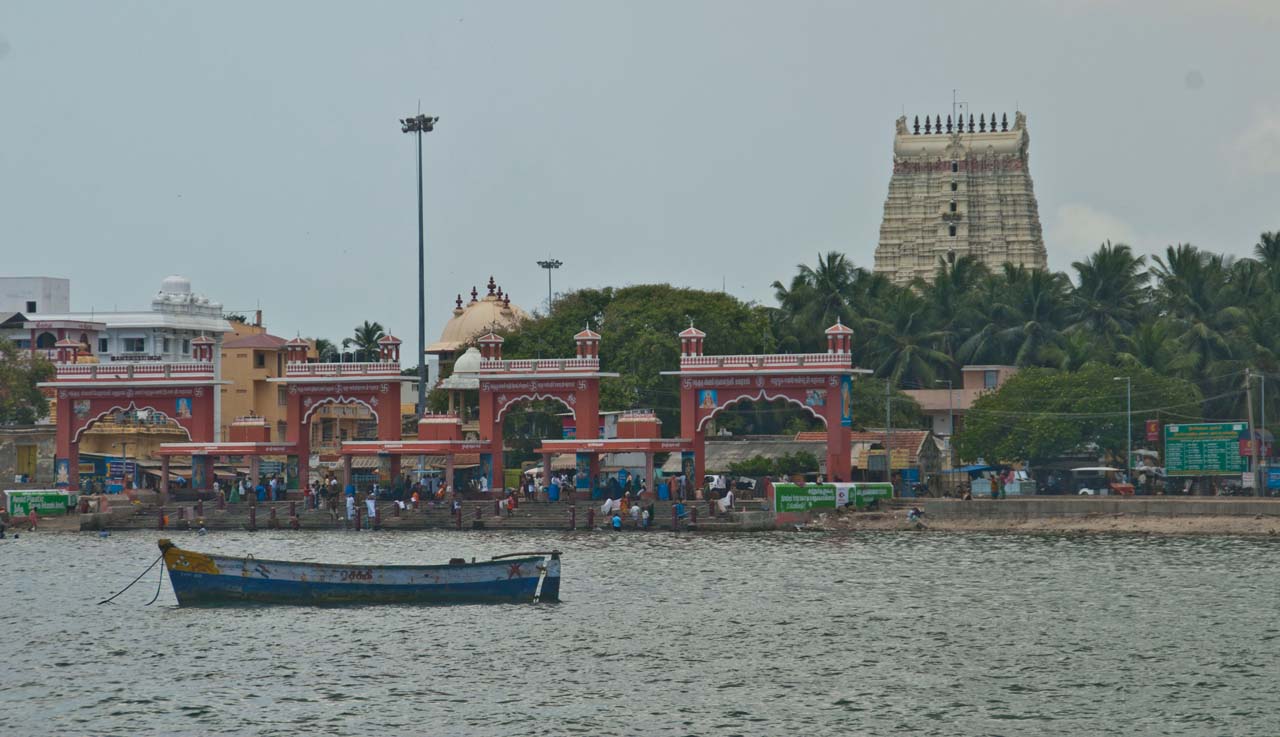
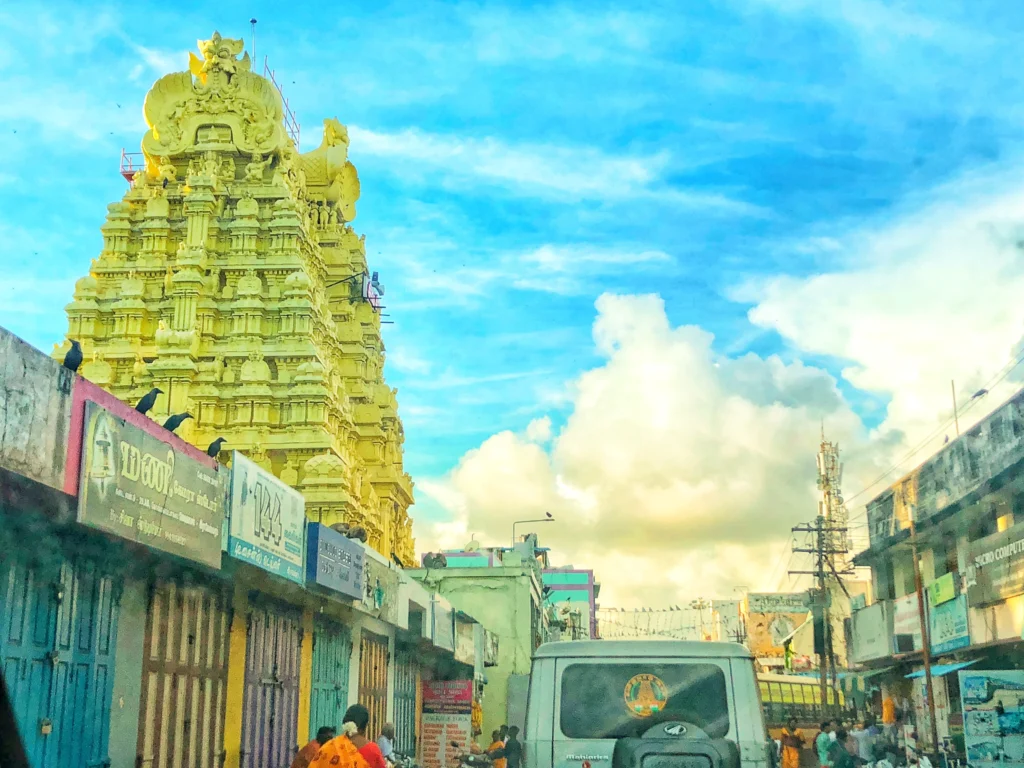
I’ll never forget crossing that bridge. Not the fancy new one everyone uses today, but the old Pamban Bridge—the one that still makes that clanging sound as trains cross over the sea. I was on a train from Madurai, crammed into a second-class compartment with half a dozen chickens, three families, and a man selling roasted corn. As we approached the island, the conductor shouted “Rameshwaram!” and the whole train seemed to wake up.
Through the window, I saw it for the first time—the temple towers rising above the palm trees, the sea stretching endlessly in every direction. The train slowed as it crossed the narrow causeway, and I pressed my face against the hot glass. That’s when I noticed something strange: the water wasn’t blue like I expected. It was this beautiful greenish color, like someone had poured emeralds into the sea.
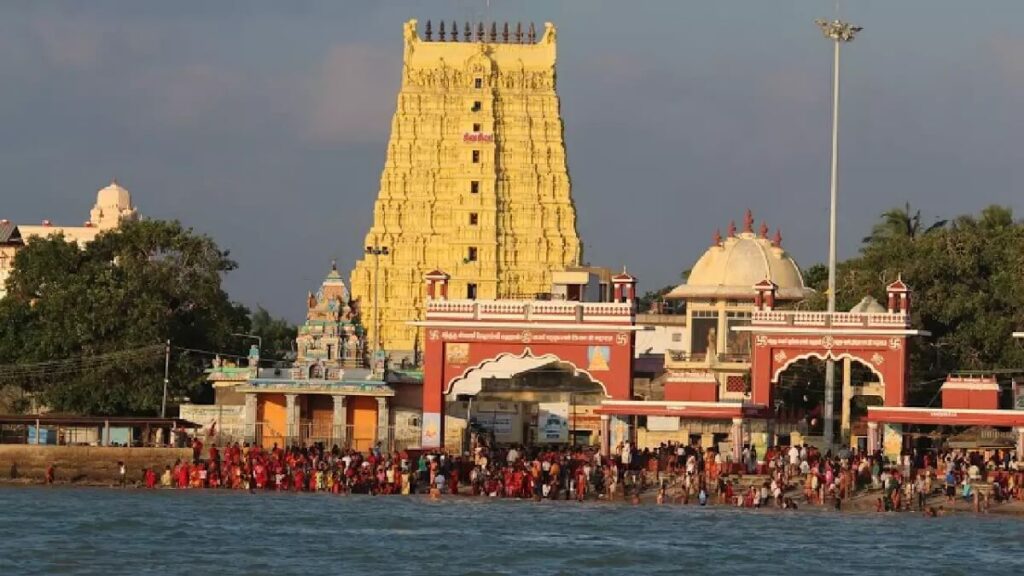
When I stepped off the train, the air hit me first—thick with salt and the smell of drying fish. Then came the sound: temple bells mixed with bicycle bells and vendors calling out “bhelpuri, garam bhelpuri!” A man in a white dhoti handed me a coconut water without me even asking, saying simply, “Welcome to Rameshwaram.”
Most people think of Rameshwaram as just another temple town, but standing there with the sea breeze in my hair, I realized this place operates on a different frequency. It’s not just a religious site—it’s a living conversation between land and water, between the divine and the everyday.
The Temple That Feels Like Home
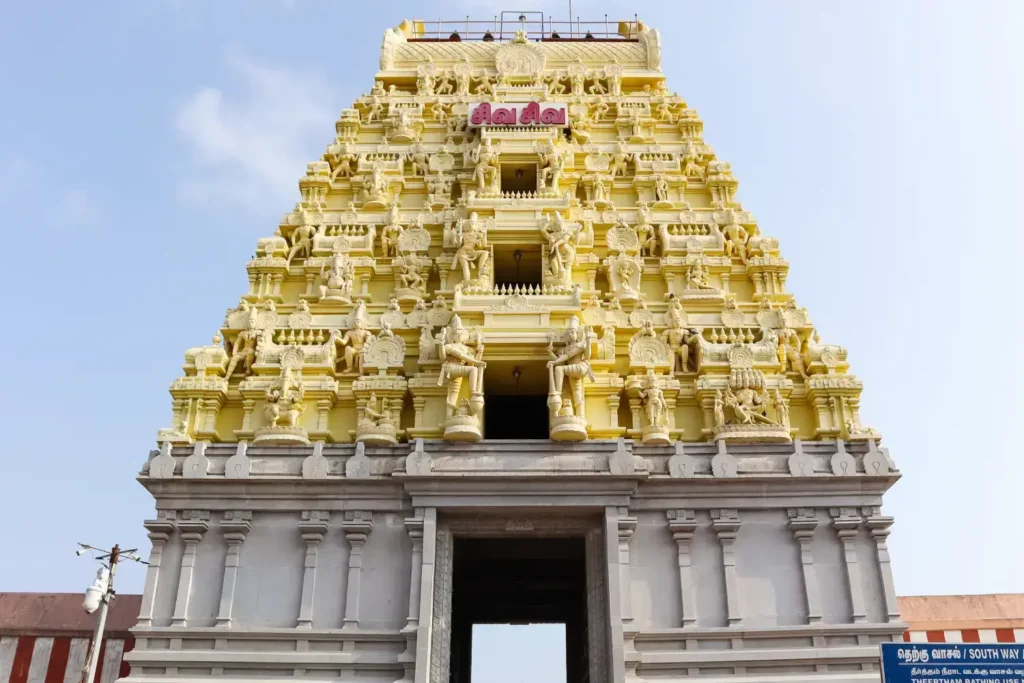
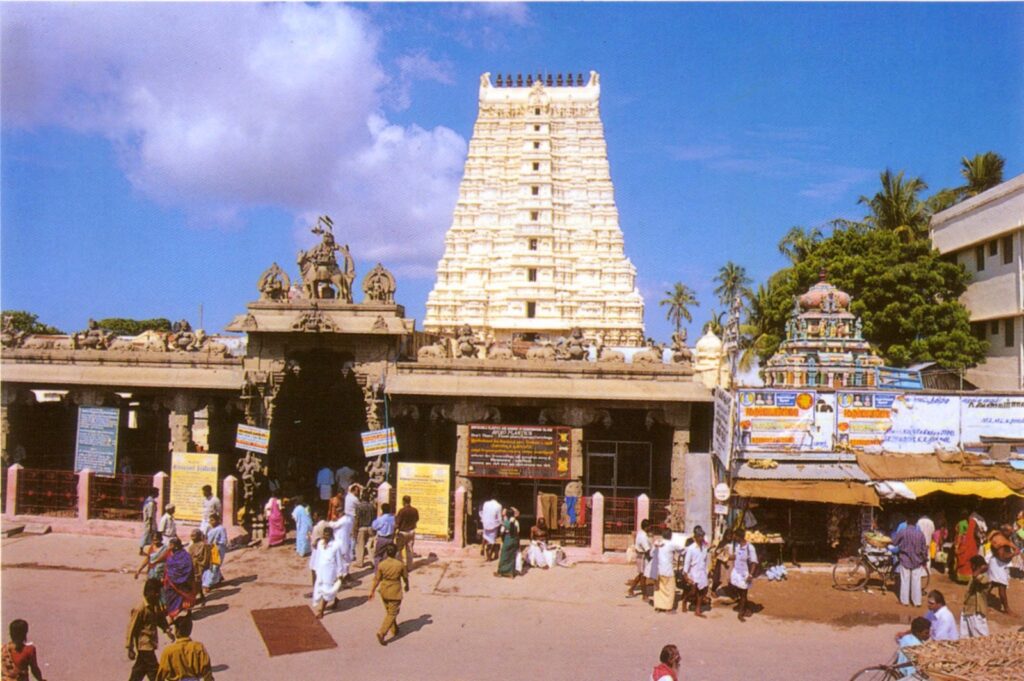
Here’s what surprised me most about Rameshwaram Temple: it doesn’t feel like a tourist attraction. Most famous temples I’ve visited have that “museum” vibe—everything behind ropes, guards telling you not to touch anything, crowds moving in one direction like cattle. But Rameshwaram feels like it belongs to the people who live here.
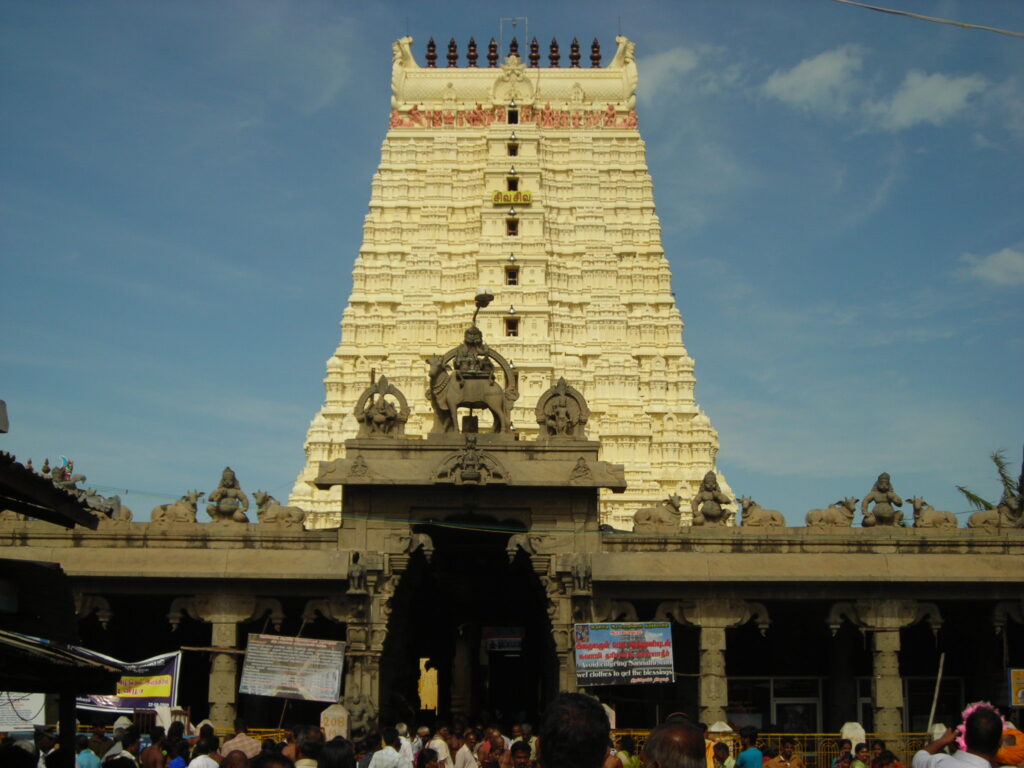
When I entered the complex (after removing my shoes and leaving them with the old man who’s been watching shoes for 40 years, he told me), I expected grandeur. Instead, I found something more real. The marble floors were worn smooth by centuries of bare feet. The walls weren’t perfectly polished—they had patches where the plaster had chipped away, revealing older layers underneath.
What struck me immediately was how ordinary people move through this sacred space. A woman in a faded saree walked past me carrying a pot of water on her head, not for ritual but for her home. Two boys played cricket in a corner of the courtyard, stopping only to touch their foreheads to the wall as they ran past a small shrine. An old man sat cross-legged against a pillar, eating his lunch from a banana leaf while softly chanting.
“This isn’t a temple you visit,” a local shopkeeper told me later. “It’s a temple that visits you. It’s in the streets, in the homes, in the sea. The temple walls are just where it gathers to breathe.”
The 22 Wells: More Than Just Water
Everyone talks about the 22 theerthams (sacred wells) at Rameshwaram, but most people don’t understand what they really are. It’s not just a checklist of places to visit—it’s a spiritual journey mapped onto the island.
I made the mistake of trying to do all 22 in one day. By the fifth well, I was exhausted, sweaty, and wondering what the big deal was. Each well looked the same to me—just a stone structure with some water in it.
That’s when I met Murugan, a retired schoolteacher who volunteers as a guide. “You’re doing it wrong,” he said, not unkindly. “It’s not about visiting the wells. It’s about what happens between them.”
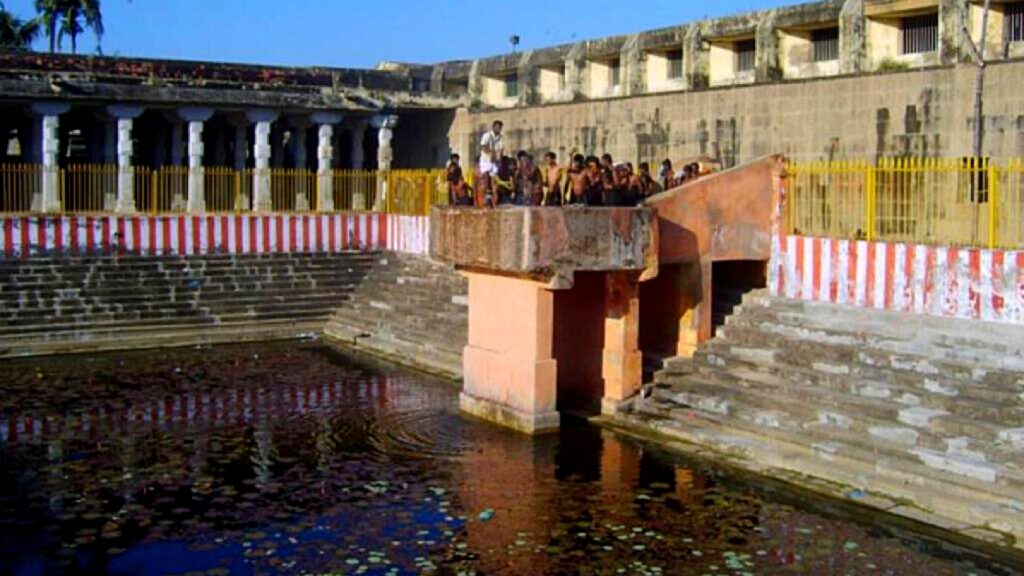
He took me to the first well, called Agni Theertham, right by the sea. “This one is special,” he explained. “Pilgrims bathe here before entering the temple.” The water was cool and clear, with a slight reddish tint I couldn’t explain.
“The color comes from the minerals,” Murugan said, reading my mind. “But it’s not just about the water. It’s about what you leave behind.” He showed me how people pour out the water they’ve carried from home before filling their pots with the well water. “They’re leaving their old selves behind,” he said.
What most visitors miss is that each well has a specific purpose:
- Some are for healing specific ailments
- Some are for particular life stages (marriage, childbirth)
- Some are only open during certain times of day
- Some require specific rituals before bathing
The real magic happens as you walk between the wells. The streets of Rameshwaram become your spiritual path. You pass homes where families invite you for water, shops where vendors give you free prasad, and small shrines where people stop to pray spontaneously. The journey between the wells is where the real transformation happens—not in the ritual itself, but in the space between rituals.
The Long Corridor: Where Time Slows Down
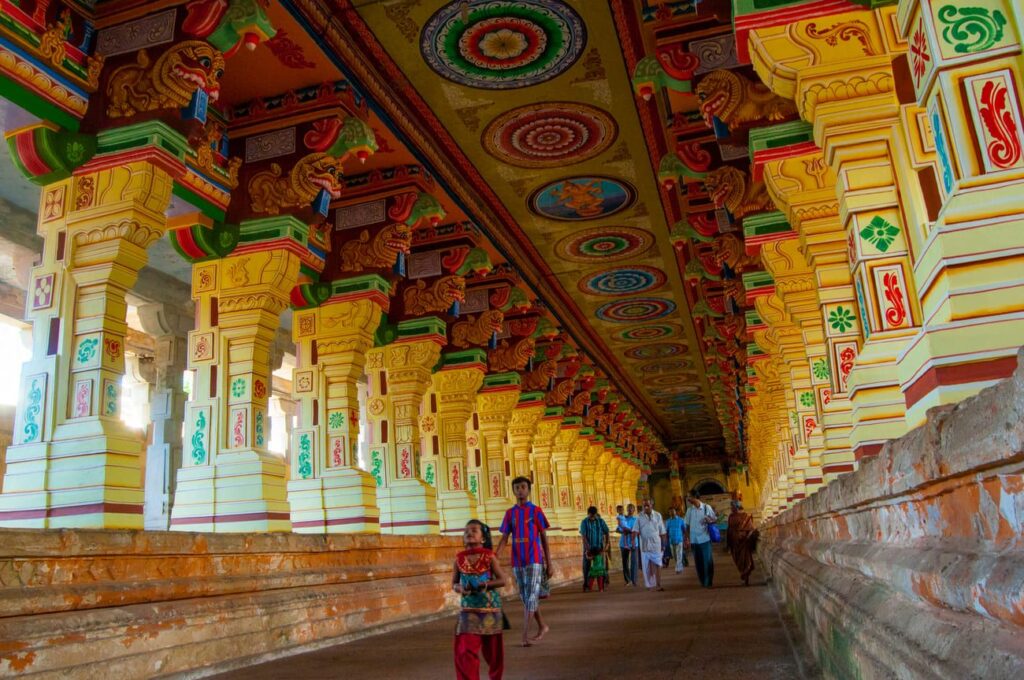
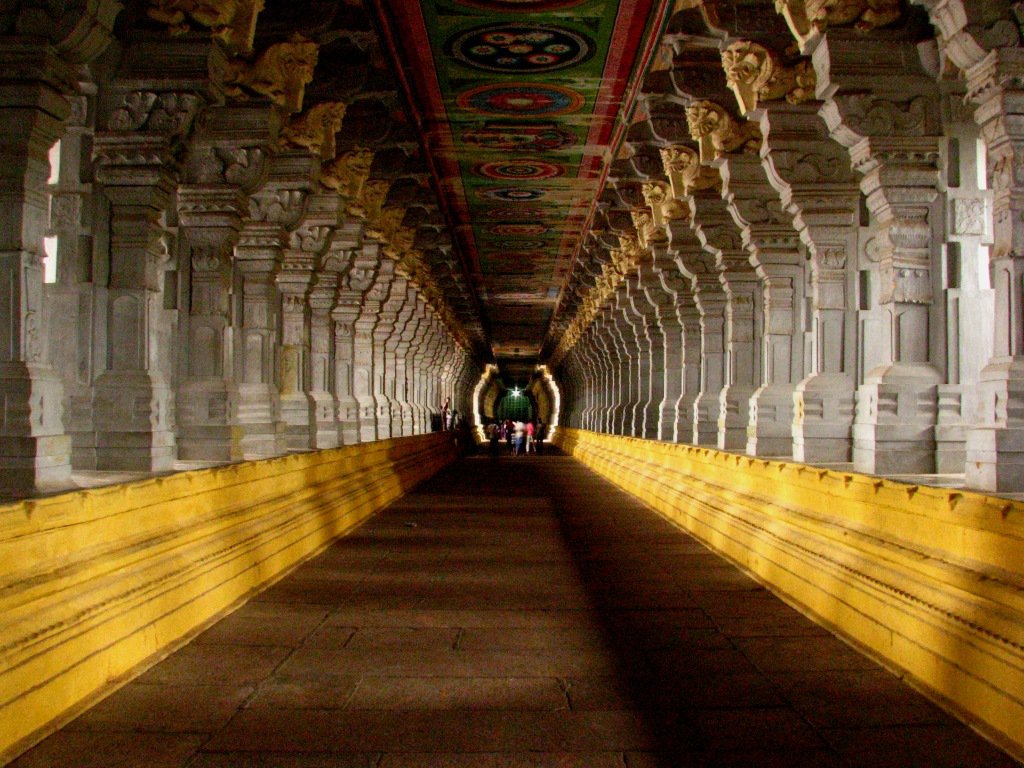
The temple’s main claim to fame is its corridor—the longest in India with 1,200 pillars. Most guidebooks describe it as an architectural marvel (which it is), but they don’t tell you what it’s really like to walk through it.
On my first attempt, I got lost within minutes. The corridor twists and turns in ways that make no sense, with identical pillars stretching as far as the eye can see. After 15 minutes of walking, I realized I was back where I started. A group of schoolchildren noticed my confusion and laughed good-naturedly, offering to guide me.
What they didn’t tell me was that the corridor is designed to be disorienting. “It’s not a mistake,” Murugan explained later. “The corridor is meant to make you lose your sense of direction so you can find your inner direction.”
The real secret of the corridor isn’t in the pillars themselves, but in what happens when you slow down enough to notice them. Each pillar has carvings that tell stories from the Ramayana, but they’re not the grand scenes you’d expect. Instead, they show everyday moments:
- Rama helping Sita fix her hair
- Hanuman sharing food with a hungry child
- Lakshmana keeping watch while Rama sleeps
“These are the moments that made Rama divine,” Murugan said. “Not the battles, but the small acts of kindness.”
The corridor is also home to hundreds of sparrows that have made nests in the crevices. Their constant chirping creates a natural soundtrack that changes with the time of day—soft in the morning, energetic at noon, peaceful in the evening. Sitting quietly in the corridor, listening to the birds and the distant chanting, I understood why people come here to meditate. Time doesn’t just slow down—it becomes irrelevant.
The Sea Connection: More Than Just Geography
Rameshwaram isn’t just near the sea—it’s in conversation with it. This relationship shapes everything about the temple and the town.
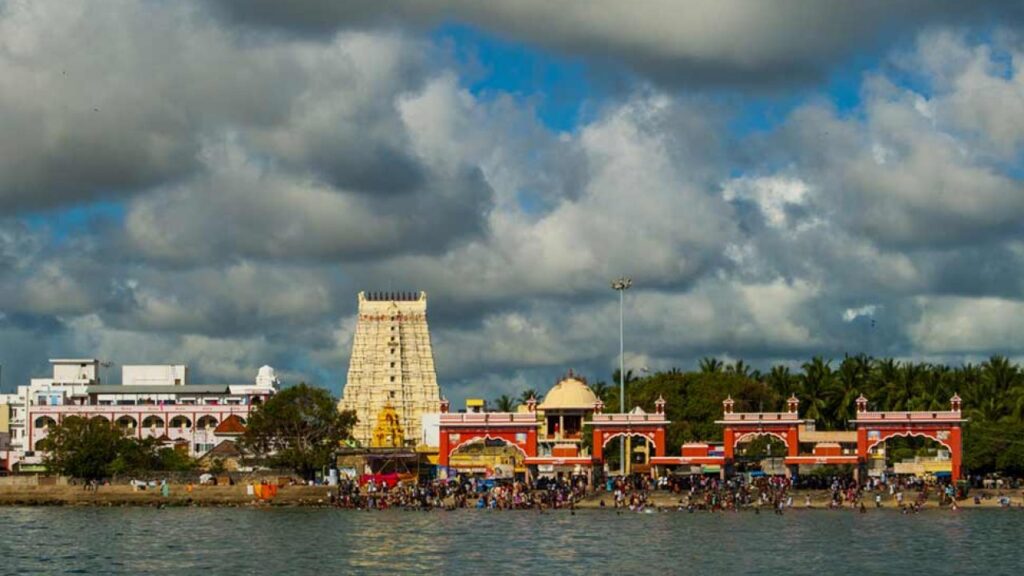
The most obvious connection is Agni Theertham, the well by the sea where pilgrims bathe. But what most people don’t realize is how the tides affect the entire temple complex. During high tide, the sea water mixes with the well water, changing its mineral composition. Priests time certain rituals to coincide with specific tidal patterns because the water’s “quality” changes with the moon.
One morning, I joined the early bathing ritual at Agni Theertham. As the first light hit the water, hundreds of pilgrims moved through the bathing area in a carefully choreographed pattern. The water was cool but not cold, and the gentle sloshing created a natural rhythm that matched the soft chanting.
An elderly woman noticed my curiosity and explained the significance of each step: “First we wash the left foot—representing the past. Then the right foot—the future. Finally, we pour water over the head—the present moment where Shiva resides.” In that simple ritual, the entire philosophy of living mindfully was contained.
The sea also affects the temple’s architecture. The walls are built with special coral stone that resists salt erosion, and the drainage system is designed to handle both monsoon rains and high tides. During my visit, I saw workers repairing a section of wall with traditional techniques passed down for generations—mixing lime, jaggery, and crushed seashells to create mortar that actually gets stronger with exposure to salt air.
The Ramayana Connection: Not Just a Story
Most temples have legends, but at Rameshwaram, the Ramayana isn’t just a story—it’s living history. What makes this place special is how the epic is woven into daily life, not just religious practice.
The temple’s main legend tells how Rama, after defeating Ravana, came here to atone for killing a Brahmin (Ravana was technically a Brahmin by birth). He built a lingam of sand, but it kept washing away in the sea. So he asked Hanuman to bring a permanent lingam from Mount Kailash. When Hanuman was delayed, Sita made a temporary lingam from sand that became known as the Ramalingam. When Hanuman returned with the Kaleshwaram lingam, Rama decided to install both, with the Ramalingam taking pride of place.
This isn’t just a story told in guidebooks—it’s visible everywhere:
- The main sanctum houses both lingams
- A small shrine marks where Sita is said to have made the sand lingam
- The well where Hanuman washed after his journey is still used for rituals
- The path Hanuman took from the sea is marked by small shrines
But what surprised me most was how this ancient story connects to modern life. At a local school, I watched children perform a play about Rama’s visit to Rameshwaram. What was remarkable wasn’t the story itself, but how they’d updated it—the set included a model of the Pamban Bridge, and Rama used a cell phone to call Hanuman for the lingam.
“This isn’t about the past,” the teacher explained. “It’s about how ancient wisdom applies to our lives today. Rama’s journey is every person’s journey.”
The Food That Feeds the Soul
Temple food in India varies widely, but the langar (community kitchen) at Rameshwaram has a special character. What surprised me most was how the food connects to the island’s geography.
I spent a morning with the kitchen staff, who welcomed me despite my clumsy attempts to help. The head cook explained that everything served here comes from the island: rice grown in the limited arable land, vegetables from small family gardens, and fish caught that morning by local fishermen.
“The food isn’t just nourishment,” she said as she stirred a massive pot of rice. “It’s prasad that carries the energy of this place.” She showed me how they prepare the special “Theertham Bhaat” (well water rice) that’s unique to this temple—using water from specific wells that have different mineral compositions.
What moved me most was learning about the “Anna Daan” (food donation) tradition. Every day, the kitchen prepares extra food specifically for the sadhus and wandering seekers who have nothing. “Shiva is everyone’s god,” the cook explained. “Not just those who can afford to visit the temple.”
During my stay, I shared a meal with a group of pilgrims from different parts of India. As we ate with our hands (as is tradition), someone shared a story about how the temple’s food had sustained them during difficult times. “This isn’t just food,” they said. “It’s love made edible.”
One unique aspect is how the temple incorporates seafood into its offerings—a rarity in Hindu temples. “The sea provides for us,” a priest explained. “So we offer back what it gives us.” The fish is prepared with special care, following strict ritual guidelines, and is considered particularly sacred.
The Night That Changed Everything
Most visitors leave by sunset, but I decided to stay. The temple provides simple accommodations for pilgrims who wish to experience the temple after the crowds depart. As the last tourists filed out, the temple transformed. The harsh fluorescent lights were turned off, replaced by traditional oil lamps that cast dancing shadows on the ancient walls.
Around 9 PM, I joined a group of sadhus for an informal discussion in the courtyard. One of them noticed my camera and said, “Put it away. The real experience happens when you stop trying to capture it.” He was right. Without the distraction of documenting everything, I began to notice details I’d missed during the day: the way the moonlight highlighted specific carvings, the different sounds of the sea at night versus day, the subtle shift in the scent of incense as the temperature dropped.
As midnight approached, the head priest invited us to witness the rare “Ratri Puja” (night worship). In the dim light of the sanctum, the rituals took on a different quality—more intimate, more personal. The priest explained that night worship connects to Shiva’s aspect as the destroyer of darkness, both literal and metaphorical.
Lying on my thin mat in the temple courtyard that night, listening to the sea below and the occasional bell from the sanctum, I understood why people come here seeking transformation. The temple isn’t just a place to visit—it’s a space that changes you if you let it.
The Mist That Changed Everything
My last morning at Rameshwaram began with an unexpected gift—a thick mist that rolled in from the sea, enveloping the entire temple complex. What could have been a disappointment (no ocean views) turned into the most profound experience of my visit.
As the mist settled, the temple transformed. Sounds became magnified—the dripping of water from the temple spire, the distant chanting, the rustle of palm leaves. Without visual distractions, my other senses heightened. I found myself noticing details I’d missed during clear days: the texture of the stone under my fingers, the subtle shifts in temperature as I moved between shaded and sunny areas, the complex layers of scent in the air.
An elderly sadhu noticed me standing quietly in the courtyard and joined me. “The mist is Shiva’s blessing,” he said. “When you can’t see the sea, you must feel it instead.” He led me on a silent walk through the temple complex, guiding my hands to touch carvings I’d only looked at before.
As we moved from shrine to shrine, he described each one in detail, helping me “see” with my hands what I’d previously only seen with my eyes. The experience was humbling and transformative—like discovering a whole new dimension of the temple I thought I knew.
When the mist finally lifted around noon, revealing the stunning view of the sea, I realized something profound: I appreciated the view more because I’d experienced the temple without it. True understanding, I realized, comes not just from seeing, but from feeling, listening, and connecting.
Practical Wisdom from My Mistakes
My journey to Rameshwaram wasn’t without its hiccups—plenty of which could have been avoided with better preparation. Here’s what I learned the hard way, so you don’t have to:
Getting There:
- The Pamban Bridge train ride is magical but book in advance
- If driving, avoid monsoon season (July-September) when roads flood
- The best time to arrive is early morning to avoid the heat and crowds
- If coming by bus, get off at the old bus stand for the most authentic experience
What to Bring:
- A lightweight rain jacket even in summer (the sea weather changes fast)
- Soft-soled shoes for the temple complex (the marble is slippery when wet)
- A small notebook for taking notes (photography is restricted in many areas)
- Small denomination rupees for offerings and donations (they don’t take cards)
Temple Etiquette:
- Shoulders and knees must be covered (carry a scarf just in case)
- Remove all leather items (belts, wallets, etc.)
- Silence is expected in the inner sanctum
- Offerings should be purchased from temple-approved vendors
Hidden Gems:
- The early morning sea bathing ritual at Agni Theertham (5 AM)
- The sunset viewpoint on the western side of the island that most tourists miss
- The weekly fish market on Fridays where you can meet local communities
- The sound garden near the main temple is most active in the early morning
What NOT to Do:
- Don’t try to negotiate with sadhus (they don’t accept money for blessings)
- Don’t eat non-vegetarian food within 5 km of the temple (it’s considered disrespectful)
- Don’t rush through rituals—observe quietly before participating
- Don’t assume all areas are open (some shrines have restricted access during certain rituals)
The Real Miracle of Rameshwaram
After five days at Rameshwaram, I realized something profound: the real miracle isn’t the ancient architecture or the dramatic location—it’s the living tradition that connects people across generations and backgrounds.
On my last evening, I sat with a group of pilgrims from different parts of India. There was a businessman from Mumbai, a fisherman from Tamil Nadu, a student from Delhi, and an elderly couple who had been coming here for 50 years. Despite their different backgrounds, they shared a common language of devotion that needed no translation.
The businessman told me, “I come here every year to reset my priorities. In the city, I measure success by money and power. Here, success is measured by how quietly you can sit and listen.”
As we watched the evening aarti (prayer ceremony), with oil lamps reflecting on the ancient stone walls, I understood what makes Rameshwaram special. It’s not just a Jyotirlinga—it’s a living community where ancient traditions breathe through modern lives.
The head priest found me packing my bag the next morning. “You’re taking something with you,” he said, not as a question but as a statement. I thought he meant a souvenir, but he shook his head. “The sea gives something to everyone who listens. What did it give you?”
I struggled to find words until I realized: Rameshwaram had given me the understanding that true spirituality isn’t about grand gestures, but about attention to the present moment—the way the light hits a stone carving, the sound of water on stone, the feeling of cool marble under bare feet.
As I walked down the path to the bus stop, I glanced back one last time. The temple glowed softly in the morning light, not as a monument to the past, but as a living presence connecting past, present, and future. The sea’s whisper had become part of me, and I knew I’d carry it long after the journey ended.
Why Rameshwaram Belongs on Your Spiritual Journey
If you’re planning a pilgrimage in India, Rameshwaram should be at the top of your list—not because it’s famous, but because it offers something increasingly rare in our disconnected world: a direct encounter with the sacred that’s woven into everyday life.
Unlike other Jyotirlinga temples that feel like destinations, Rameshwaram feels like a homecoming—a place where the divine isn’t confined to stone but flows through every alley, every face, every wave of the sea. It’s not just about checking off a famous temples list; it’s about experiencing the living heart of Hindu spirituality.
During your visit, you’ll discover that Rameshwaram isn’t just a place to see—it’s a space to be. In a world obsessed with doing and achieving, this temple offers the radical practice of simply being present. And that, perhaps, is the greatest gift any spiritual journey can offer.
So if you’re seeking more than just another stop on your pilgrimage in India, consider making the journey to Rameshwaram. Not for the Instagram photos or the checklist completion, but for the chance to stand where the sea whispers prayers—a place where the divine doesn’t just reside, but actively welcomes you home.
The Island That Lives Within You
Leaving Rameshwaram isn’t like leaving other places. The island doesn’t stay behind as a memory—it becomes part of you. The rhythm of the sea continues in your heart, the cool marble beneath your feet lingers in your bones, and the scent of incense remains in your clothes long after you’ve left.
What stays with you isn’t just the beauty of the architecture or the intensity of the rituals, but a deeper understanding: that sacred spaces aren’t just locations on a map, but living landscapes that shape how we experience the divine. Rameshwaram teaches that spirituality isn’t confined to temples—it flows through rivers, permeates islands, and pulses in the rhythm of daily life.
As the last glimpse of the temple disappeared behind the train window, I thought about the old man who had handed me coconut water on my first day. I never learned his name, but his simple words—”Welcome to Rameshwaram”—had become my guiding principle. In a world obsessed with capturing experiences, Rameshwaram had taught me the deeper value of simply being present.
The sea’s whisper continues to guide me, reminding me that true spirituality isn’t about reaching destinations, but about transforming how we travel the journey. And that, perhaps, is the greatest gift any temple can offer—a new way of seeing the sacred in everything.
FAQs on Rameshwaram Temple
1. Where is Rameshwaram Temple located?
It is situated on Rameswaram Island in Tamil Nadu, India.
2. Why is Rameshwaram Temple famous?
It is one of the 12 Jyotirlingas and is renowned for its massive corridors and 22 holy wells where pilgrims perform rituals.
3. What is the legend of Rameshwaram Jyotirlinga?
It is believed that Lord Rama worshipped Lord Shiva here after defeating Ravana to absolve sins.
4. What are the temple timings?
The temple usually opens from 5 AM to 1 PM and again from 3 PM to 9 PM.
5. What is the best time to visit Rameshwaram?
October to April is ideal, when the weather is pleasant.
6. What is special about the 22 holy wells?
Each well has water with unique taste and healing properties; pilgrims bathe here for purification.
7. How can visitors reach Rameshwaram Temple?
Rameshwaram is connected by rail and road; the nearest airport is in Madurai, about 170 km away.
8. Is there any dress code for the temple?
Yes, traditional attire is recommended for both men and women when entering the temple.
9. What is the architectural significance of the temple?
The temple is known for having the longest corridor in the world, with intricately carved pillars.
10. Which festival is celebrated grandly at Rameshwaram Temple?
Maha Shivaratri and Rama’s victory celebrations (Ramalinga worship) are celebrated with great devotion.

One thought on “Rameshwaram Temple – Famous Jyotirlinga in Tamil Nadu”