
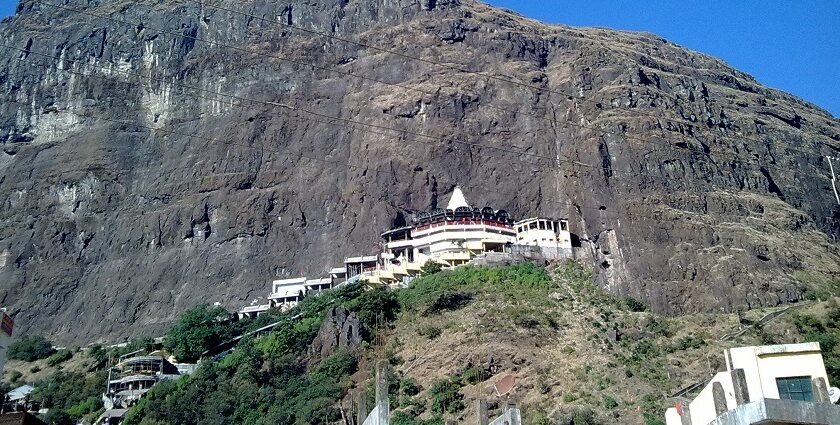
The Saptashrungi Temple, a jewel nestled in the Sahyadri mountain range near Nashik, Maharashtra, is far more than a pilgrimage site it’s an experience where spirituality, mythology, and breathtaking natural beauty converge. Its name, literally meaning “seven peaks” (Sapta-seven, Shring-peak), defines its majestic location, where the goddess Saptashrungi Nivasini, a form of Goddess Durga, resides.

The Sanctity and Deep Roots of Saptashrungi
The temple holds a paramount position in Hindu spirituality as one of the three and a half Shakti Peethas (seats of power) in Maharashtra, and one of the 51 Shakti Peethas across the Indian subcontinent.
The Mythological Essence
The profound sacredness of Saptashrungi is rooted in two primary legends:
- The Shakti Peetha Connection: According to the Puranas, following the self-immolation of Goddess Sati (the first wife of Lord Shiva), the grief-stricken Shiva performed the Tandava (cosmic dance of destruction) carrying her body. To calm him and save the world, Lord Vishnu used his Sudarshana Chakra to dismember Sati’s body. It is widely believed that Sati’s right arm (or one of her limbs, hence the “half” Peetha status) fell on this mountain. This event imbued the Saptashrungi hills with immense divine energy.
- Mahishasura Mardini: The idol of the goddess is renowned for being an 18-armed manifestation of Durga, hence her title Mahishasura Mardini (slayer of the buffalo demon Mahishasura). The legends state that the Goddess took this terrifying, powerful form to annihilate the demon Mahishasura, who had troubled the universe. A stone buffalo head at the base of the hill near the start of the climb is traditionally considered the vanquished demon.
- The Sage and the Sacred Text: Less known is the connection to Sage Markandeya. It is believed he performed intense penance on the hill directly opposite the main temple, now named Markandeya Parvat after him. He is said to have recited the Devi Mahatmya or Durga Saptashati (700 verses in praise of the Goddess) here. A local belief holds that the self-manifested idol of the goddess in the main temple is slightly tilted, with her hand near her ear, signifying her posture while listening intently to the Sage’s recitation.
A Unique Travel Guide: Beyond the Standard Itinerary
While the temple is well-connected and offers modern amenities, a truly fresh and genuine pilgrimage or visit requires moving beyond the standard route.
The Pilgrim’s Ascent: The Step Challenge
Most visitors opt for the modern Funicular Trolley (ropeway) for a quick, scenic, and comfortable ascent to the temple entrance. However, for a genuine spiritual and physical experience that connects you to generations of pilgrims, one must consider the old path.
- The Path Less Travelled (The 500 Steps): While a motorable road now reaches a plateau near the temple, the final segment involves around 500 to 510 rock-cut steps. These steps, many of which were built by Umabai Dabhade in 1710 AD, are the true pilgrim’s route. The journey up this path, shaded and echoing with the chants of fellow devotees, is a form of tapasya (penance) in itself. Plan for an hour, take breaks, and let the spiritual weight of the climb settle in.
- The Parikrama (Circumambulation): A truly unique experience, seldom detailed in general guides, is the circumambulatory path around the Saptashrungi hills. This path is high up in a steep, rocky topography. It’s a challenging trek, generally performed by the most ardent devotees. If undertaken, it offers spectacular, untouched views of the Sahyadri and allows you to physically traverse the “seven peaks” that give the Goddess her name. Note: Inquire locally for safety and official permissions before attempting any strenuous trekking.
Exploring the Untouched Water Bodies and Herbal Forests
The region is said to host 108 Kundas (water bodies/ponds), and its forests are historically known for medicinal herbs, so much so that some versions of the Ramayana legend suggest Hanuman visited Saptashrungi to find the life-restoring Sanjeevani herb for Lakshmana.
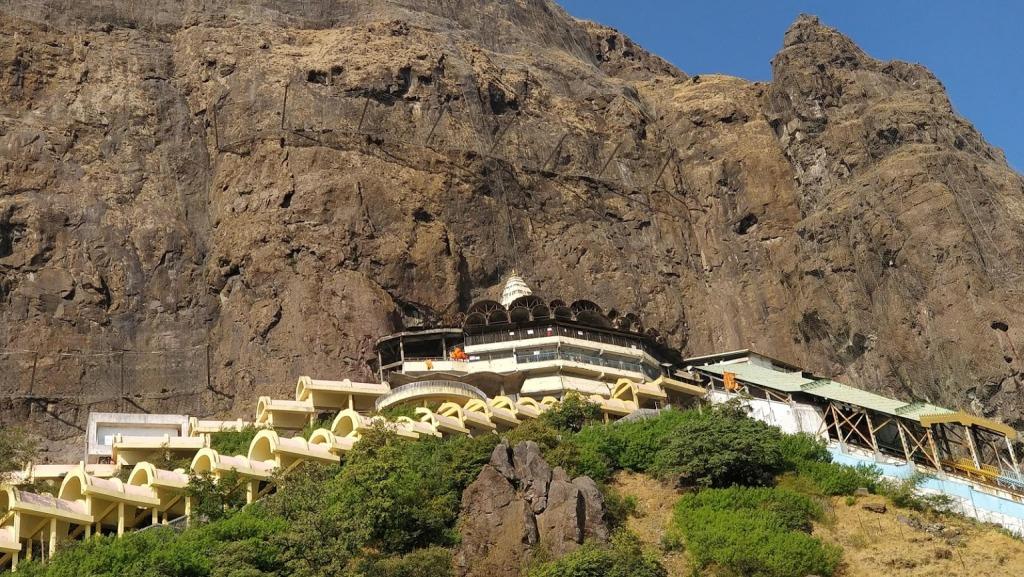
- The Markandeya Parvat View: Instead of just rushing back, allocate time to visit the Markandeya Parvat viewpoint. Not only is it the site of the sage’s penance, but it offers the most magnificent panoramic view of the Saptashrungi hill, allowing you to truly appreciate the “seven peaks.” The view of the main temple structure, carved into the cliff face, from here is unparalleled.
- The Local Aarti Experience: While the main temple Aarti is majestic, seek out the early morning Kakad Aarti (around 5:30 AM) or the late evening Sanj Aarti (around 7:00 PM). These are less crowded than the midday ritual and allow for a deeper, more personal immersion in the devotional atmosphere, where the ancient hymns resonate with the mountain silence.

Practical Wisdom for the Genuine Traveler
- Best Time to Visit: The winter months (October to March) are ideal for comfortable weather. However, for a powerful visual experience, the Monsoon (June to September) transforms the seven peaks into lush, misty green paradises, though the road and steps can be slippery.
- The Power of the Prasadalay: Don’t miss the temple’s Prasadalay (community kitchen). While a nominal donation is often requested on non-festival days, the simple, clean, and nutritious Prasad (meal) is a central part of the pilgrimage tradition, symbolizing the Goddess’s benevolence to all her children. It is an experience of community and humility.
- Accommodation: While budget accommodation is available near the base village of Vani, for a more relaxed and comfortable stay, it is recommended to base yourself in Nashik City (about 60-70 km away) and take a day trip. The drive is scenic and well-connected by MSRTC buses and private taxis.
- A Local Myth to Keep in Mind: A persistent local myth speaks of a tiger that enters the garbhagriha (sanctum sanctorum) every night to keep watch over the temple, departing before sunrise. While one should respect the wildlife of the surrounding hills, this tale captures the wild, untamed nature of the divine power believed to reside here.
The Architectural and Idolic Marvel
The temple itself is a marvel, built in front of a natural cave carved into the sheer cliff face. The 10-foot-tall, self-manifested (Swayambhu) idol of the Goddess is the centerpiece. She is eternally coated in Sindoor (vermilion), adorned with a magnificent nose ring (Nath), a crown, and necklaces. The sight of the eighteen arms, each holding a celestial weapon, is one of power and grace a rare sight among Durga forms.
In essence, a visit to Saptashrungi is an ascent both physical and spiritual. It’s an opportunity to connect with a powerful manifestation of the Divine Mother, Mahishasura Mardini, who is the protector and giver of strength, all while surrounded by the raw, captivating beauty of the Sahyadri mountains. Embrace the climb, listen to the local lore, and let the seven peaks guide your spirit.
Frequently Asked Questions (FAQ’s)
Where is Saptashrungi Temple located?
Saptashrungi Temple is located near Vani in the Nashik district of Maharashtra, around 60 km from Nashik city.
Why is Saptashrungi Temple famous?
It is one of the 51 Shakti Peethas in India, where Goddess Saptashrungi Nivasini is believed to reside among seven mountain peaks.
How can I reach Saptashrungi Temple?
You can reach the temple by road from Nashik or Vani. The nearest railway station is Nashik Road, and there’s also a ropeway for an easy climb to the temple.
What are the temple timings?
The temple remains open daily from 6:00 AM to 6:00 PM, but timings may vary during festivals.
When is the best time to visit Saptashrungi Temple?
The best time to visit is between October and March, when the weather is pleasant and ideal for climbing or using the ropeway.
Is there accommodation near Saptashrungi Temple?
Yes, several dharamshalas, guesthouses, and hotels are available near the temple premises and in Vani town.

One thought on “Saptashrungi Temple Nashik – History, Timings, Ropeway & Travel Guide”