
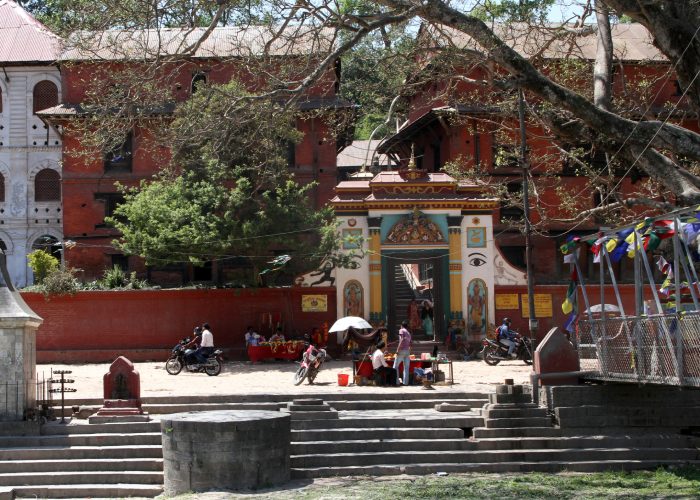
Nestled subtly on the southern bank of the holy Bagmati River in Kathmandu, Nepal, stands the Guhyeshwari Temple, a profound sanctuary that whispers rather than proclaims its divine power. Known as the Mahashira Shakti Peetha, this temple is a cornerstone of the subcontinent’s spiritual geography, a sacred site where the cosmic grief of Lord Shiva found its grounding, and the divine feminine energy, or Shakti, manifested in her most enigmatic form.
The very name, Guhyeshwari, is a confluence of the Sanskrit words Guhya (secret or hidden) and Ishwari (goddess), establishing its identity as the “Goddess of Secrets” or the “Hidden Goddess” an apt title for a place that is as much a spiritual metaphor as a physical shrine.

The Genesis of a Sacred Seat: Mahashira in the Legend
The legend of the 51 Shakti Peethas is one of Hinduism’s most poignant narratives, born from the tragic self-immolation of Sati, the first consort of Lord Shiva, in protest against her father Daksha’s insult to her husband. Driven mad by grief, Shiva wandered the cosmos carrying her lifeless body, performing the Tandava, the dance of cosmic destruction. To save the universe, Lord Vishnu used his Sudarshana Chakra to dismember Sati’s corpse. Wherever a fragment of her body or ornament fell, a Shakti Peetha, a seat of primordial power, was established.
At the Guhyeshwari Temple, the specific part of Sati’s body believed to have fallen is subject to some beautiful textual variations, all pointing to the core creative essence of the feminine. While the Puranas often cite the dropping of her knees (Mahashira), some Tantric traditions believe it was her pelvic region (or guhya the hidden part) that sanctified this spot.
Regardless of the exact body part, the consensus is that this location is eternally charged with the very source of feminine creation, grounding the ephemeral cosmic power into the tangible realm. Here, the Goddess is worshipped as Mahashira or Guhyakali, and her consort, Lord Shiva, is revered as Kapali (the Skull-Bearer), representing the inseparable duality of the universal father and mother.

A Hidden Gem: Architecture and Esoteric Worship
Unlike the towering Shikhara style temples common in India, the Guhyeshwari Temple is a striking example of the traditional Nepalese Pagoda architecture. Its multi-tiered, gilded roofs, adorned with four golden snakes symbolizing protection, give it a distinct, almost cloistered beauty. However, the true architectural and spiritual uniqueness lies within the Garbhagriha (sanctum sanctorum).
Instead of a conventional, standing idol of the Goddess, the shrine features a flat, ground-level water-filled kalasha (pot) covered with silver and gold plating. This unique representation is considered a symbolic yoni or the primordial womb the ultimate source of power and creation. Devotees offer their prayers by bowing down low to this elemental, formless representation, an act that underscores the Tantric nature of the worship.
The temple’s association with Tantra is profound. It is mentioned in revered texts like the Kali Tantra and Shiva Tantra Rahasya as one of the most potent centers for spiritual energy. According to local lore, the temple is constructed over seventeen cremation grounds a concept that in Tantra symbolizes the conquering of the fear of death and the transcendence of the mortal form to achieve true spiritual power. This focus on the “secret” and the esoteric has made it a central pilgrimage site for serious Tantric practitioners and yogis.

The Inseparable Duo: Shakti before Shiva
The Guhyeshwari Temple holds an extraordinary place in the spiritual landscape of Kathmandu due to its adjacency to the world-famous Pashupatinath Temple of Lord Shiva. This proximity is not mere coincidence; it is a profound spiritual mandate.
Devout pilgrims universally follow a ritualistic sequence: they must first pay homage to Goddess Guhyeshwari before proceeding to offer worship at the Pashupatinath Temple. This tradition is steeped in the ancient philosophy that acknowledges the primacy of Shakti (the divine feminine energy) before Shiva (the divine masculine consciousness). It is Shakti that animates Shiva; the creative force must be honored before the transcendent consciousness. For the devotee, a pilgrimage to Pashupatinath is spiritually incomplete without bowing before the ‘Goddess of Secrets’ who empowers the ‘Lord of Animals.’ The two temples are thus seen as two sides of the same transcendental coin, embodying the necessary and eternal union of Prakriti (Nature/Energy) and Purusha (Consciousness).

A Confluence of Faiths: Bridging Hinduism and Buddhism
The spiritual resonance of Guhyeshwari extends beyond Hinduism. In the Vajrayana Buddhist tradition, the temple is equally revered. Buddhists consider the site sacred to Vajrayogini in the form of Vajravarahi (the Diamond Sow), and it is sometimes associated with the root of the mythical lotus upon which the great Swayambhunath Stupa rests. This shared sanctity reflects the unique syncretic culture of the Kathmandu Valley, where Hindu and Buddhist deities and places of worship often seamlessly intertwine, demonstrating a deep, underlying spiritual unity.
The Whispers of Power: Rituals and Blessings
The daily rituals, or Nitya Puja, are performed by a traditional priestly clan, the Karmacharya, following the ancient Sarvamnaya Tantra. The environment of the temple is one of profound tranquility and deep reverence, especially during the early morning hours.
The most potent time for worship is during the auspicious Dashain and Navaratri festivals, when the air is thick with the chanting of mantras and the vibrant energy of devotees. Women, in particular, flock to the temple seeking blessings for a long, devoted marriage and the longevity and health of their husbands, linking the Goddess of Creation directly to the sanctity of marital life. It is believed that a dedicated visit can bless a couple for soul-mate connection over several lifetimes a testament to the Goddess’s power over the most hidden and essential human connections.
In essence, the Guhyeshwari Temple is more than just the Mahashira Shakti Peetha; it is a living embodiment of the divine feminine’s mysterious power, a constant reminder that true strength often resides in the secret, hidden places, patiently waiting for the sincere seeker to look inward and discover the Goddess of Secrets within themselves.
Frequently Asked Questions (FAQ’s)
Where is Guhyeshwari Temple located?
Guhyeshwari Temple is located on the banks of the Bagmati River in Kathmandu, Nepal, close to the famous Pashupatinath Temple.
Why is Guhyeshwari Temple famous?
It is one of the Shakti Peethas, where Goddess Sati’s body part is believed to have fallen. The temple is dedicated to Goddess Parvati (Guhyeshwari), the divine consort of Lord Shiva.
What are the temple timings?
The temple is generally open from 5:00 AM to 7:00 PM, with special pujas during festivals like Dashain and Navaratri.
How can I reach Guhyeshwari Temple?
It’s located about 2 km from Tribhuvan International Airport and easily accessible by taxi or local transport from anywhere in Kathmandu.
When is the best time to visit Guhyeshwari Temple?
The ideal time to visit is between October and March, when the weather is pleasant and major Hindu festivals take place.
Is photography allowed inside the temple?
No, photography is usually not permitted inside the temple premises due to its sacred significance.

One thought on “Guhyeshwari Temple Kathmandu – History, Timings & Travel Guide”