

Nestled amidst the emerald folds of the Jaintia Hills in Meghalaya, the Nartiang Durga Temple stands not just as an ancient shrine but as a living testament to a profound cultural and historical syncretism. Estimated to be over six hundred years old, this revered site is one of the subcontinent’s 51 Shakti Peethas, a sacred abode of the Divine Feminine, and a magnificent confluence where the indigenous traditions of the Khasi-Jaintia people meet the enduring spiritual force of Hinduism.
Its story is inextricably linked with the rise and patronage of the Jaintia Kingdom, creating a narrative that is as compelling as it is sacred.
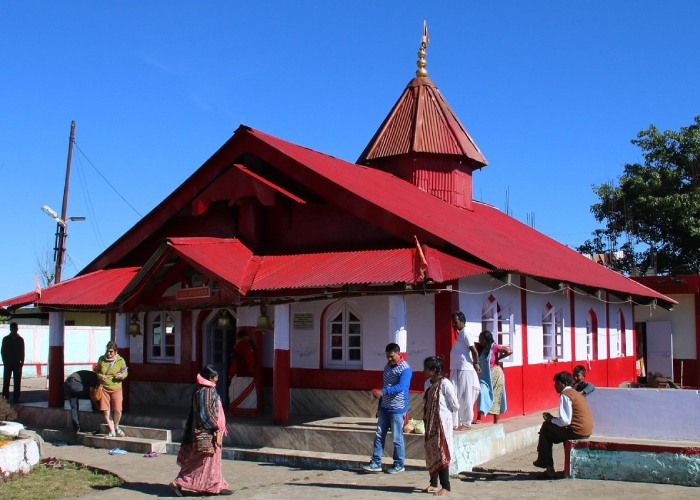
The Mythological Foundation: Jayanti Shakti Peetha
The spiritual bedrock of the Nartiang Temple rests on one of Hinduism’s most powerful legends: the mythology of the Shakti Peethas. According to the Puranic texts, these 51 holy sites mark the places where the dismembered body parts of Goddess Sati, the first wife of Lord Shiva, fell during Shiva’s cosmic dance of sorrow, the Tandava. The Nartiang Temple is believed to be the spot where Sati Devi’s left thigh descended upon the Earth.
This association bestows upon the site an immense sanctity, transforming the temple into a pilgrimage destination of national importance.Here, the Goddess is worshipped as Jayanti (The Victorious One), and her corresponding male energy, the Bhairava, is known as Kamadishwar. The local deity is also reverently referred to as Jainteshwari, a name that intrinsically links the divine presence to the land and the people of the Jaintia Hills, cementing the belief among the Hindu community that this is the permanent residence of Goddess Durga.
A Chronicle of Kings and Conversion: The Jaintia Connection
The history of the temple is deeply interwoven with the political landscape of the erstwhile Jaintia Kingdom, a powerful entity that held sway over a significant territory in what is now Meghalaya, Assam, and parts of Bangladesh. Nartiang itself served as the summer capital of the Jaintia Kings, a strategic location that speaks to the temple’s early importance.
The establishment of the current temple structure is often attributed to the 17th-century Jaintia King, Jaso Manik (reigned 1606–1641). While the Jaintia royalty traditionally followed the indigenous Niamtre faith, their exposure to neighbouring kingdoms, particularly the Hindu Koch kingdom, led to a cultural shift. King Jaso Manik’s marriage to Lakshmi Narayana, the daughter of the Hindu Koch King Nara Narayana, is a pivotal moment.
It is believed that the Queen, an ardent devotee of Goddess Durga, profoundly influenced the royal family’s adoption of the Shakti sect of Hinduism.
A local legend holds that the Goddess herself appeared to King Jaso Manik in a dream, revealing the sanctity of the location and commanding him to build a temple in her honour. This divine mandate solidified the temple’s position as a royal shrine.
The strategic location, coupled with the remnants of weaponry like cannons found within the complex, suggests that the temple was once part of a larger fortification, emphasizing its dual role as a centre of spiritual life and a symbol of the Jaintia Kingdom’s military strength and royal patronage.
Architecture: A Hill-Style Syncretism
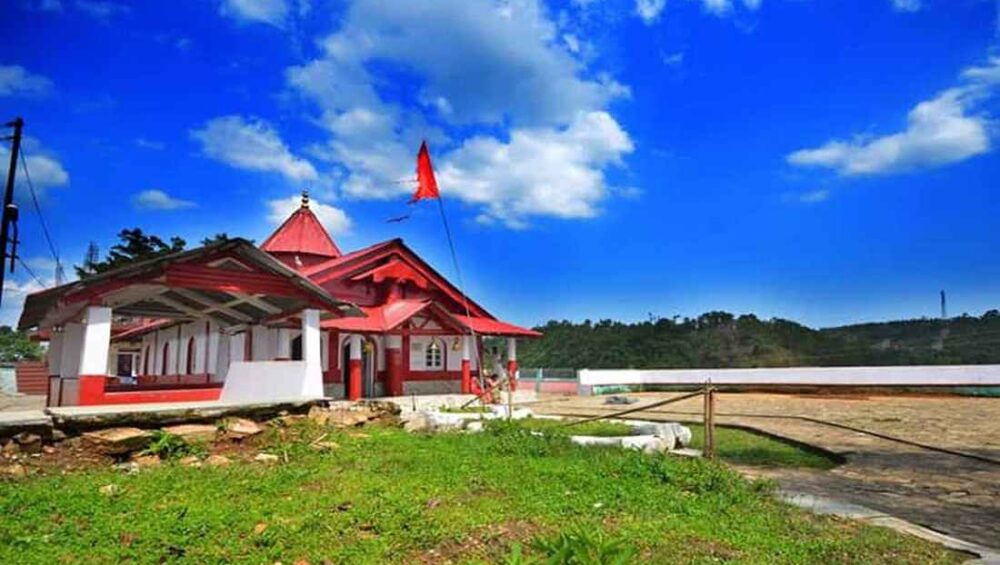
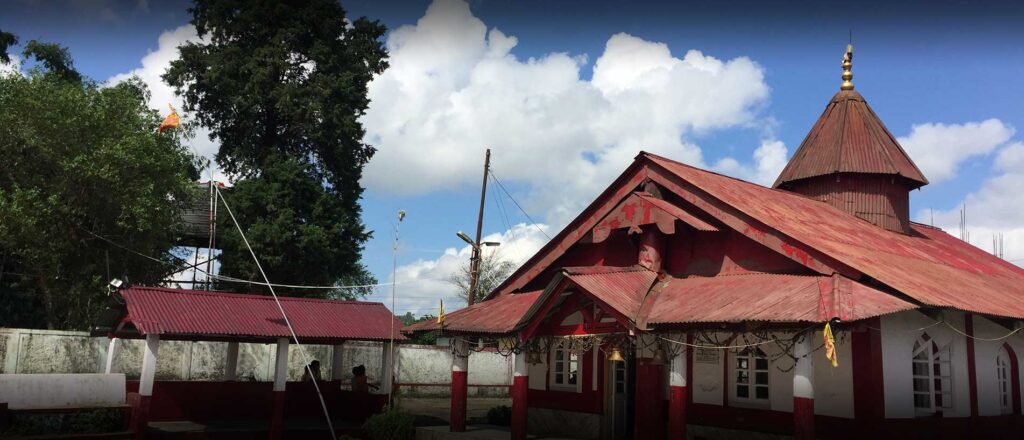
Unlike the towering and profusely sculpted temples of peninsular India, the Nartiang Durga Temple exhibits a unique architectural modesty that reflects its local cultural roots and the environment of the hills. Initially, the structure is said to have resembled a traditional Khasi house, complete with a thatched roof and a central wooden pillar, or Dieng Blai.
Over centuries, the architecture evolved, incorporating influences from the plains while maintaining a distinct hill character. Today, the structure, predominantly built of stone, possesses an understated, almost austere beauty. Later modifications, such as the replacement of the thatch with corrugated tin and the addition of a steeple-like element to the roof, showcase the continuous blending of styles.
Despite these changes, the temple complex’s unique identity remains intact, including the presence of ancient, colossal monoliths the largest collection of megalithic stones in a single area of the Khasi and Jaintia Hills erected by past Jaintia rulers to commemorate various victories and events. These monoliths, with the tallest one raised by the trusted lieutenant U Mar Phalyngki, stand as silent sentinels, adding a layer of historical mystique to the spiritual precinct.
A Fusion of Faith: The Unique Durga Puja Rituals
The most striking embodiment of the temple’s cultural fusion is witnessed during the annual Durga Puja celebration, the most important festival here. The rites performed at Nartiang are far from the conventional practices observed in the plains, presenting a fascinating blend of Hindu and ancient Khasi-Jaintia traditions.
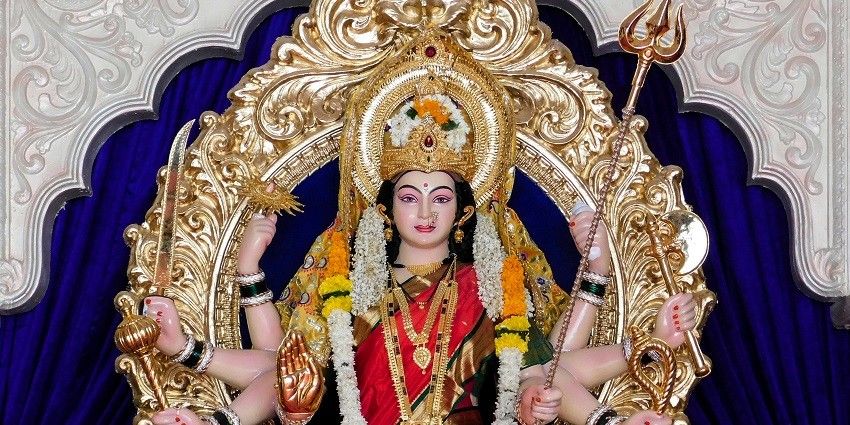
In strict adherence to the Khasi custom of not using figurine images for divine worship, the central image of Goddess Durga is not a sculpted idol. Instead, the Goddess is represented by a plantain (banana) trunk, which is ceremoniously dressed in a saree and decked with marigold flowers. This plantain trunk, worshipped over the four days of the festival, is known as the Utsav Murthy. The rituals are overseen by the local chieftain, or Syiem, who is considered the chief patron of the temple.
Historically, the temple was infamous for the practice of human sacrifice during the reign of the Jaintia kings. This gruesome custom, which included a steep tunnel reportedly leading from the sanctum to the Myntdu River down which the sacrificed heads were rolled, was banned during the British colonial era.
In its place, animal sacrifice, specifically that of goats, continues to be a part of the Maha Ashtami rituals, often involving a ceremonial goat dressed in human attire a symbolic nod to the ancient, forbidden practice. At the end of the four-day festivities, the banana trunk representing the Goddess is ceremoniously immersed in the Myntdu River, accompanied by a traditional gun salute, marking the Vijaya Dashami or Dussehra.
A Legacy Under the Green Canopy
The Nartiang Durga Temple is more than just a historical or mythological landmark; it is a profound cultural sanctuary. It embodies the harmonious coexistence of diverse spiritual paths, showcasing how indigenous reverence for the natural world and pan-Indian Hinduism merged under the patronage of a powerful kingdom.
The temple, with its peaceful atmosphere, surrounded by scenic hills, and its proximity to other regional attractions like the Nartiang Monoliths, the Sajar Nangli Lake, and the majestic Tyrshi Falls, offers a journey through history, spirituality, and the breathtaking natural beauty of Meghalaya. It remains a sacred beacon, inviting pilgrims and travellers alike to witness a unique and timeless spiritual tradition preserved under the green canopy of the Jaintia Hills.
Frequently Asked Questions (FAQ’s)
Where is Shri Nartiang Durga Temple located?
Shri Nartiang Durga Temple is located in Nartiang village, in the West Jaintia Hills district of Meghalaya, about 65 km from Shillong.
Why is Nartiang Durga Temple famous?
It is one of the 51 Shakti Peethas in India and holds immense significance as the place where the left thigh of Goddess Sati is believed to have fallen.
Who built the Nartiang Durga Temple?
The temple was built by the Jaintia Kings over 500 years ago, reflecting a unique blend of Hindu and tribal architectural styles.
What are the temple timings?
The temple is open daily from 6:00 AM to 7:00 PM for devotees, with special rituals during Durga Puja and Navaratri.
How can I reach Nartiang Durga Temple?
You can reach Nartiang by road from Shillong or Jowai. The nearest major city is Shillong, about 2–3 hours away by car.
When is the best time to visit Shri Nartiang Durga Temple?
The best time to visit is between October and April, especially during Durga Puja, when the temple comes alive with traditional celebrations.

One thought on “Shri Nartiang Durga Temple Meghalaya – History, Timings & Travel Guide”